Mobirise Website Builder

CDM 2024

Assalamualaikum and Good morning everyone. My name is Fiqri.
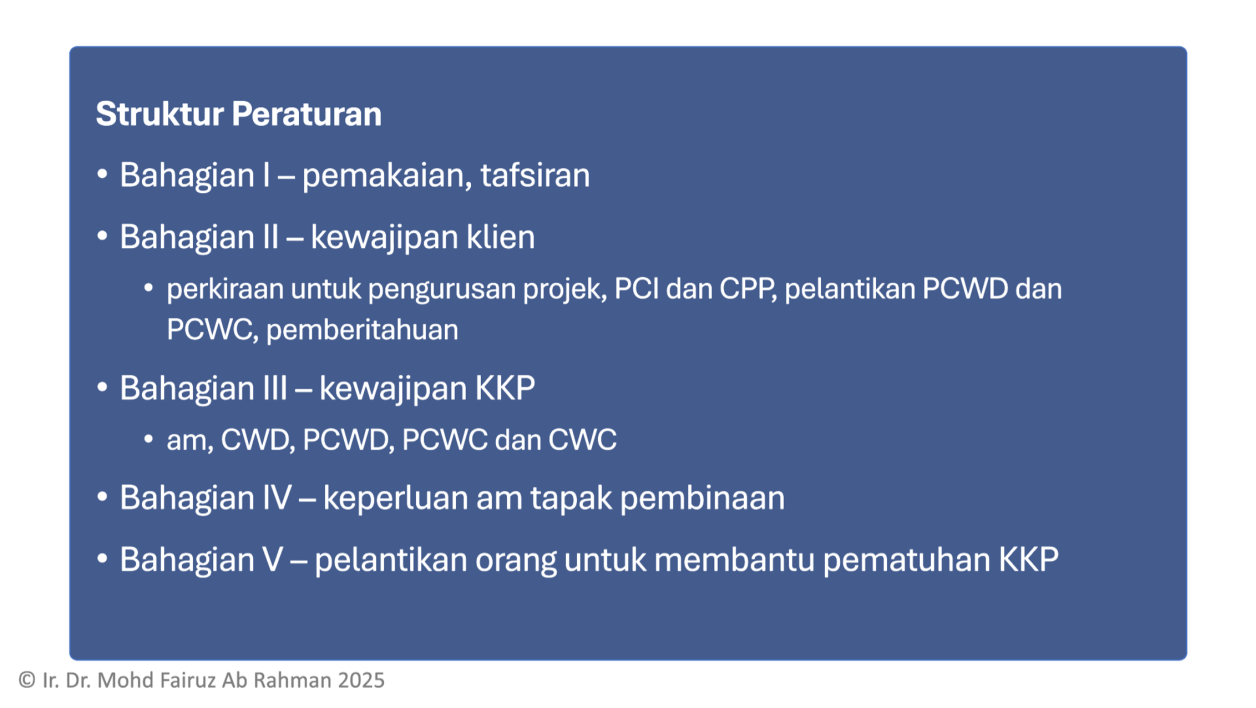
In this module, we are going to look at the CDM regulations, enforced since the 1st of June 2024, from the perspective of the life cycle of a construction project. This regulation is gazetted under the Occupational Safety and Health 1994, and has replaced the Factories and Machinery (Building Operation and Works of Engineering Construction) (Safety) Regulation 1986 or BOWECS.
It should be noted that the CDM applies to all places of work in which a project is carried out in Malaysia, from the initial design through to completion of the construction work.
It is also noteworthy that there is no minimum threshold of level, scale or intensity for construction activity such that the CDM would not apply.

Mobirise Website Builder

Project Life Cycle

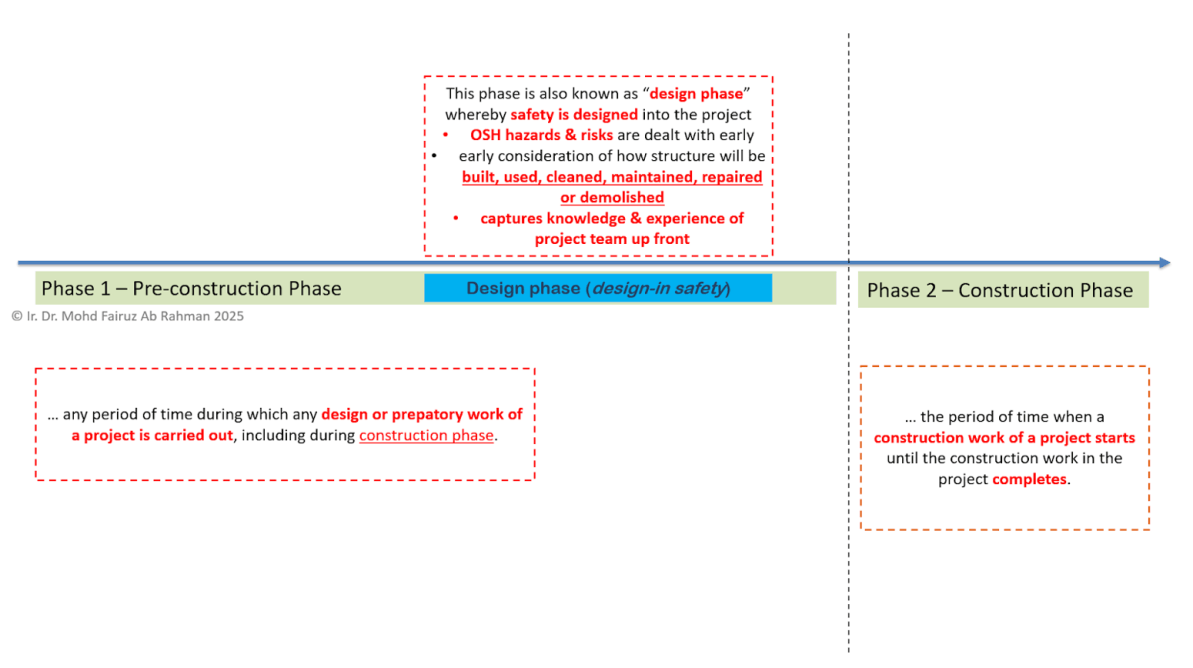
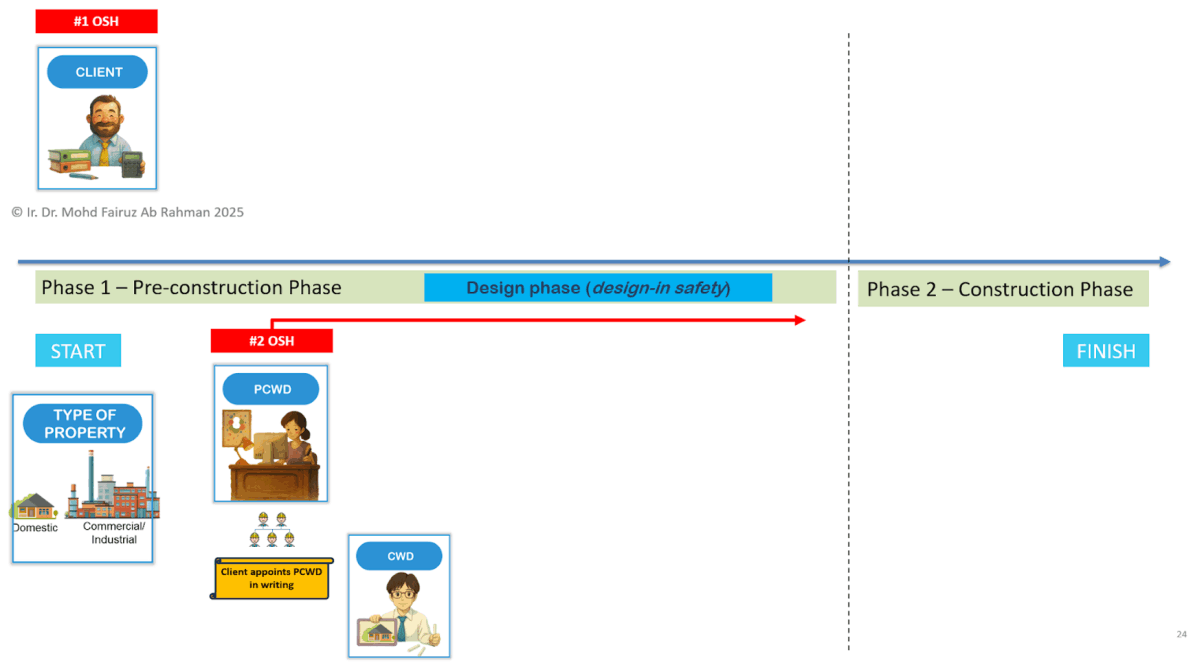
From the perspective of the CDM regulations, the life cycle of any construction project is divided into two phases, namely the pre-construction phase, the first phase before any construction work starts and the second phase is the construction phase.
CDM defines the pre-construction phase to have meaning as any period of time during which any design or preparatory work of a project is carried out, including during the construction phase.
Phase number two, the construction phase, means the period of time when a construction work of a project starts until the construction work in the project completes.
What is really important to note, the pre-construction phase is also known as the design phase because this is where we have to design in safety or some may call it design out risks related to safety and health of workers. That is designing safety into the project.
What it generally means is that the occupational safety and health or OSH hazards and risks are dealt with early, upstream of the project life cycle. Designers or specifically the construction work designers give early consideration of how a structure will be built, used, cleaned, maintained, repaired or demolished. This process tries to capture knowledge and experience of the project team up front, focusing on prevention of OSH risks through design.

Mobirise Website Builder

Construction Work

When we look at the construction project, we are going to think of that client right up front. Without a client, the project will never exist.
The CDM simply defines a client as any principal or any person for whom a project is carried out. In the OSHCIM guidelines 2017, it explains that the clients can be individuals or organisations, including local authority, state governments or federal government. Clients also include corporations, limited companies, partnerships and the management corporation.
Just think about what client wants a project to be done. That could be any building or structure like say an office, a hotel or hospital. It could be a factory conversion or shop renovation. If it is in the house, family dwelling, that is going to be obviously a domestic client. The OSHCIM guidelines explains that homeowners who engage contractors to build their homes or undertake projects to build or rebuild houses for personal dwelling not intended for use as a business are domestic clients. Specifically, domestic client means a client for whom a project is being constructed or carried out, which the project is not in the course or furtherance of a business of that client.
On the type of property. That’s important because that type of property is going to determine the type of client. Remember, if we are a client getting some work done on our own property, we’re not required to understand the CDM regulations and neither do we need to. Domestic clients are, by default, exempted to comply with the CDM. All other clients (may be known as industrial or commercial clients) are required to comply with the CDM.
It is vital to appreciate the definition of construction work, because any activity that is not within the definition of ‘construction work’ is not subject to the CDM. Construction work is defined as meaning the construction of any building, civil engineering or engineering construction work and includes—
(a) the construction, alteration, conversion, fitting out, commissioning, renovation, repair, upkeep, redecoration or maintenance including cleaning which involves the use of water or an abrasive at high pressure, or the use of corrosive or toxic substances, de-commissioning, demolition or dismantling, of a structure;
(b) the preparation for an intended structure, including site clearance, exploration, investigation and excavation, and the clearance or preparation of the site or structure, for use or occupation at its conclusion;
(c) the assembly on site of prefabricated elements to form a structure or the disassembly on site of the prefabricated elements which immediately before such disassembly, formed a structure;
(d) the removal of a structure, or of any product or waste resulting from any demolition or dismantling of a structure, or from disassembly of prefabricated elements which immediately before such disassembly, formed such a structure;
(e) the installation, commissioning, maintenance, repair or removal of mechanical, electrical, gas, compressed air, hydraulic, telecommunications, computer or similar services which are normally fixed within or to a structure,
The construction work does not include the work associated with mineral exploration or extraction, as provided for at the end of the definition of construction work, which states:
‘but does not include the exploration for, or extraction of, mineral resources, or preparatory activities carried out at a place where the exploration or extraction is carried out’
Thus, all work concerned directly with mineral exploration or extraction, including deep and opencast coal mining, clay pits, sand, stone and aggregate extraction, is expressly excluded.
Any project, by definition, has a clear start and end point. So, it is really convenient to think of CDM by way of the life cycle. A project is defined as any project which includes or is intended to include a construction work and includes all planning, design, management or other work involved in a project until the end of the construction phase. It is apparent that a project comes into being at the very early stages of planning and design. 

Mobirise Website Builder

Client Duty

That first phase there, we can see so client’s have number 1 OSH written above them there. It is unarguable that the role of the client is central to the procurement of construction work. This is due to the client’s influence over the budget and other resources and the time frame within which the project is conceived through to completion of construction. The CDM has further increased the responsibility of the client because the client has the greatest influence on the management of a project. Clients are expected to take an active role to ensure that construction work is carried out with proper attention to the OSH risks to workers. The client’s role is not necessarily one of management but is definitely one of leadership.
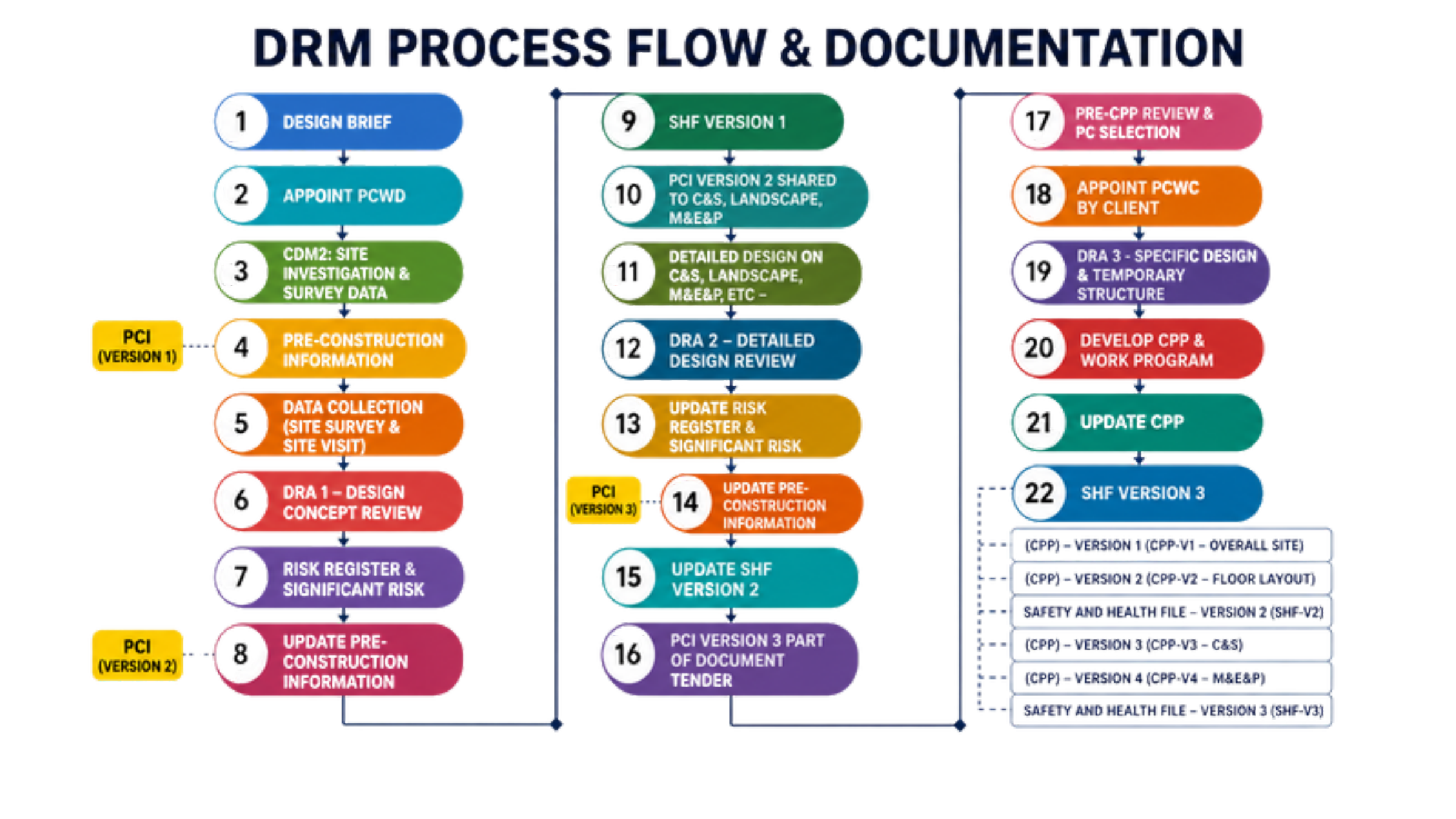
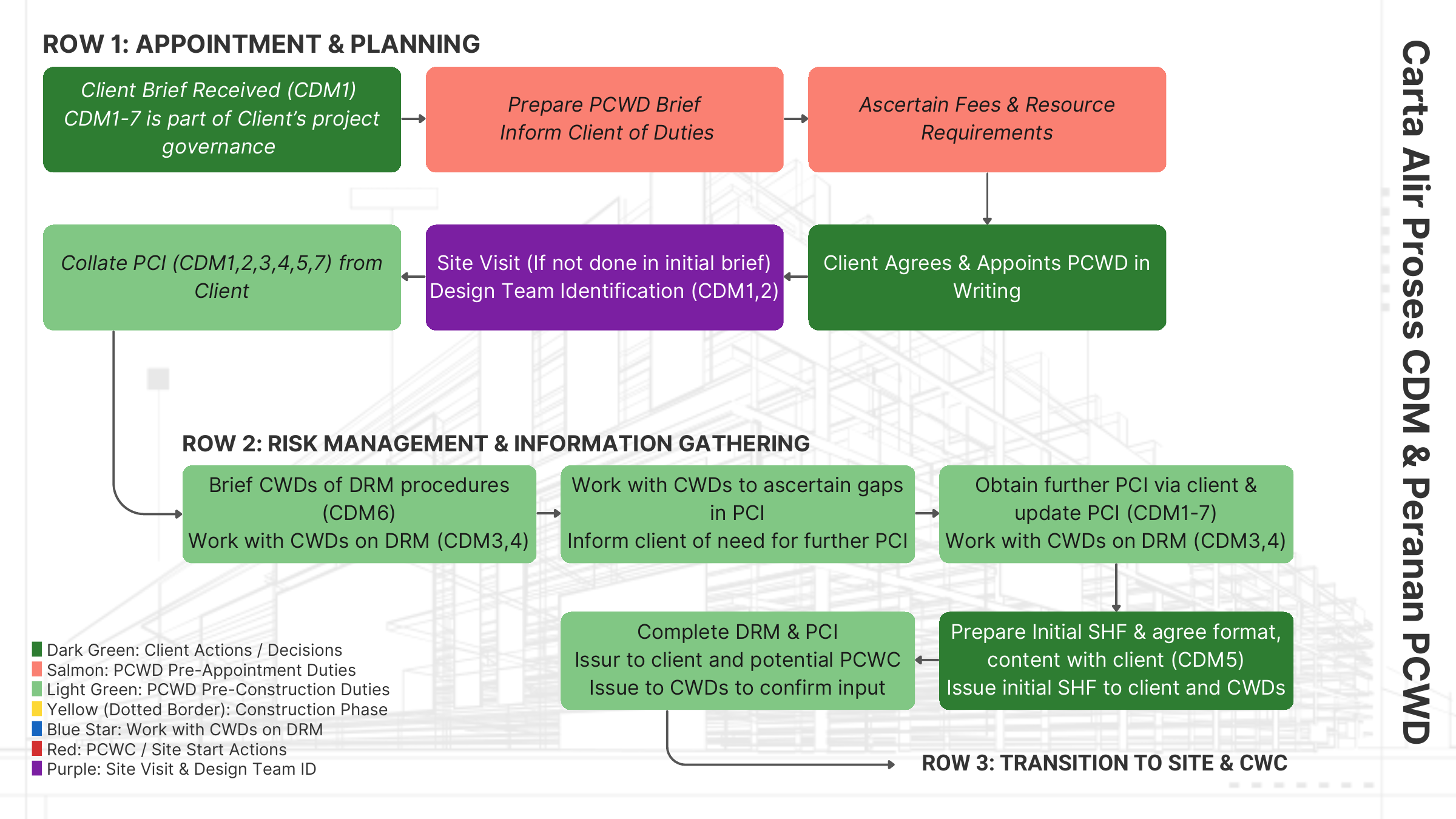
Now, if we look at number 2, we have the introduction of the construction work principal designer or PCWD. They are somebody who’s appointed in writing by the client by virtue of regulation 7(1)(a). The PCWD must be a Construction Work Designer or CWD with control over the preconstruction phase. The appointment of a PCWD is mandatory on all projects where there is more than one contractor, or it is reasonably foreseeable that there will be more than one contractor, irrespective of the scale of the project and regardless of whether the project is notifiable. On all projects, it is the client who has to appoint the PCWD in writing, and in doing so must ensure that the PCWD carries out the responsibilities in regulations 12, 13 and 14.
The PD is responsible for the OSH in that pre-construction phase and they are going to usually give that guidance to the client. They’re there to support the client. The PD is that person who gives advice. The preparation of the pre-construction information or PCI is a vital stage in a project, and the regulation 12(2)(e) envisages that the PCWD will be available to assist in the task. For this reason, the client is required to make a PCWD appointment as soon as practicable before the construction phase begins. In the event that the appointment of a PCWD is delayed, the client assumes the responsibilities of the PCWD in accordance with regulation 7(3)(a). The client who unwittingly assumes the responsibilities of the PCWD is exposing themselves to considerable commercial and OSH management risks if they do not have the skills that would be expected of a PCWD.
The Construction Work Designer or CWD is defined as any person who in the course or furtherance of a business or undertaking (a) prepares or modifies a design; or (b) arranges for, or instructs, any person under their control to prepare or modify design, relating to a building, structure, product or mechanical or electrical system intended for a particular structure. Thus, any person can be a designer, including a client and construction work contractor. In fact anyone who contributes or gives input to design without realising are taking part in the design process.
Design means any drawings and its details and includes any specification and bills of quantity, including specification of any plant or substance, relating to a structure, and any calculation prepared for the purpose of the design. It is within most people’s contemplation that design would include the preparation of drawings, calculations and specifications, but note, in particular, that the preparation of bills of quantities is included within the definition of design. The inclusion of bills of quantities indicates the importance of the allocation of financial resources for safety measures.
Even in the most straightforward circumstances of preparing or modifying a design, a person may not be aware that their contribution will be part of the design process. In fact, because designs are rarely finalized until the point of installation or construction, all persons involved in the decision-making up to the point of installation or construction are likely to be CWD. It should also be noted that the design does not have to be a neat set of written calculations or instructions but that a design can be communicated orally and therefore extends the categories of persons likely to be fulfilling the role of a CWD.

Mobirise Website Builder

Pre-construction Phase

And we are still discussing matters within the pre-construction phase. Here, we got the client brief and again we will go through that in a little bit more detail.
The client brief fundamentally is a document whereby the client outlines what that project is. So we can see there, they give the clients expectations, limitations, budget, planning constraints, time scales, safety in design (PtD), risk register, RAG lists. This client brief is really important for OSH, but it does not have to be written down. There’s no legal requirement for that. But it is beneficial because then it can be reviewed and referred to as we go along. That’s the client giving their expectations - what they want the project to be. Often when an organisation has an accident or an incident, when we start doing that investigation, quite often it will be stated that the timelines have slid to the right hand side and things were getting pushed. However we still had the same amount of time. So, really important the client has that overall input and legal responsibility for that client, for that construction phase, for the entire phases of the project, when they are a commercial client.
Then we have the pre-construction information. That’s really important. That’s going to be coming from the client. In the legislation, it says that the client shall provide this pre-construction information as soon as is practicable. Now, in most cases, the client doesn’t really know what they need to do, which is where the PCWD steps in to help them out. So, the PCWD is going to pull that and because that pre-construction information is going to be needed by the principal construction work contractor or PCWC. What is pre-construction information? That’s going to be things like location of underground services, location of overhead services, normal site risk assessments. Anything to do with the location, with the building, could be environmental, could be safety, OSH, could be absolutely anything the construction work contractors, the construction work designers need to know about the property.
Now, the depth and complexity of the paperwork, namely the PCI, CPP and the SHF, varies with the risk and complexity of the project. For example, if you’re doing a big lifting operation, you may need to do a bit of extra survey on the ground to see if the crane and the ground, for example, the concrete can take the weight of what you're trying to lift and so on. Now, in a lot of cases, the PCWD steps in to help the client out. Now, again, this varies if you’re dealing with a big kind of commercial project. Maybe it’s like a big business, trying to build a new building or something. Typically, they’re going to have like a safety team that knows what they’re talking about but more often than not, the client actually has very little idea what they need to provide and where they’re going to get it and how they’re going to give and so on.
The PCWD really needs to coach the client, make sure they’re aware of their duties and help them fulfil those duties. So, in a nut shell, that is the first piece of paperwork you’re going to come across. Pre-construction information, and in my opinion it is probably the second most important piece of information you’re going to get. It’s phenomenally important. Pre-construction information is so important, predominantly it’s a legal requirement for the client to do it but the PCWD often ends up stepping in, holding their hand and coaching through.
The safety and health file. The client got to consider that. That starts getting to be put in phase one, in the pre-construction phase as well as in phase two, the construction phase, when we go there. 

Mobirise Website Builder

Construction Phase

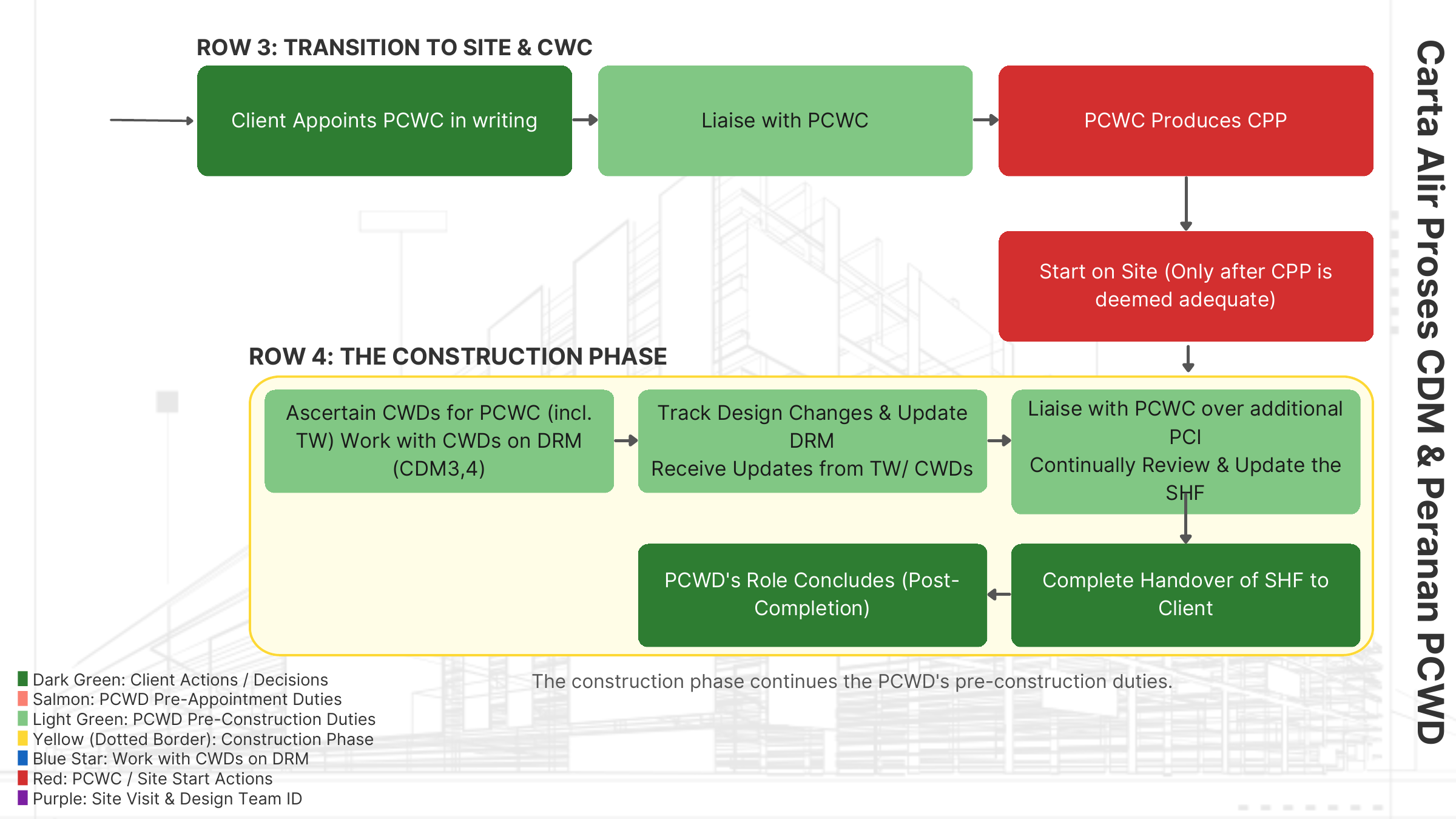
This is when the PCWC comes into their own because we’ve got work to be done, shovels are in the ground, we could say that. The PCWC is responsible for that phase. Regulation 39 specifies that PCWC must appoint a site safety supervisor or SSS to assist them. PCWC must ensure that there’s welfare on site. We can see that I put welfare up with the client because the client must ensure that welfare is on site. The PCWC, when they were bidding or tendering for the work, they should have ensured that they considered the welfare requirements. But we can see multiple things from toilets, sanitary, washing facilities, soap, drinking water, and a seating area where workers can sit down and eat their food. Welfare facilities are really important and usually contribute to the healthy conditions of the site workers. It is also important as is security. The site must be secure. We can see there’s specific regulation, in regulation 20 for the security of site. That security and the site must be kept in good working order.
We welcome the SHF back so we can see it’s been considered in the preconstruction phase with all information going into it. We can also note the SHF actually further than the actual finish time of the project because it is contained within it and is going to be guides for any subsequent projects. The SHF as required by the CDM regs is only required when there are more than one construction work contractors.
I think that’s important because when there is more than one CWC, before the project is over. If they do, that responsibility is passed to the PCWC. So the two documents will cease to exist after the project is completed.
So we can see the two clear phases there. But the next thing we must be really really aware of, as we can see there. It is the client that has overall control and ownership of that entire project when they are a commercial client.

We must also be thinking here, we can see this yellow box because within that yellow box we're thinking of what the CWDs must do. They must eliminate, reduce or control risks through the design. We've looked at the design phase there, the CWDs must follow the general principles of prevention (GPP).
At all times the CWDs must be thinking of the maintenance, cleaning and access to the finished project and that's the last the last sort of popup slide there and that's that of us. As a summary, we must be aware of all five elements of CDM. And also we must be fully aware of this construction phase if we are going to be giving guidance or acting for the principal designer, the client or the principal contractor as consultants and advisers we must be fully knowledgeable of these two phases.

A Quick Knowledge check.
How many construction phases are there? Well there are two: the pre-construction phase and the construction phase.

Which phase could be considered as the design phase? Remember phase one because that's before construction, we are having to design in safety. Design safety into the project.

What are those three duty holders? They are the client, the principal designer and the principal contractor. They must work together to ensure safety and health. Occupational safety and health (OSH) is a priority.

Mobirise Website Builder

Connect, innovate, succeed

With a spirit of innovation, we navigate uncharted territories, exploring new ideas, technologies, and approaches. It is through our willingness to challenge conventions and think beyond boundaries that we discover innovative solutions that propel us forward.

Mobirise Website Builder

Learn how to create unique content

Lorem ipsum dolor sit amet, consectetur adipiscing elit. Donec egestas massa vel nulla gravida pulvinar. Pellentesque habitant morbi tristique senectus et netus et malesuada fames ac turpis egestas.

Drag and Drop Website Builder